Indigo Road has grown from one steak house on Broad Street to 40 eateries in seven states
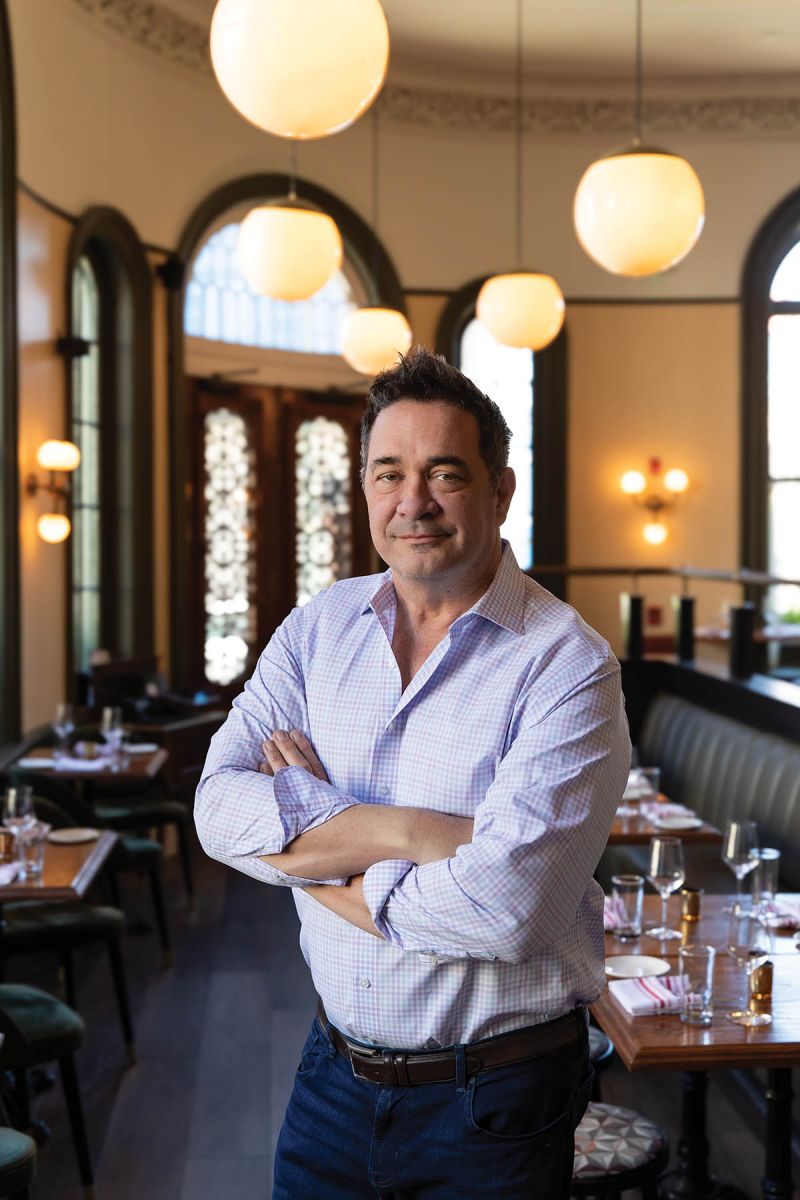


“I have a one meeting rule,” Steve Palmer says. “I’ll always take a meeting, because you just never know.”
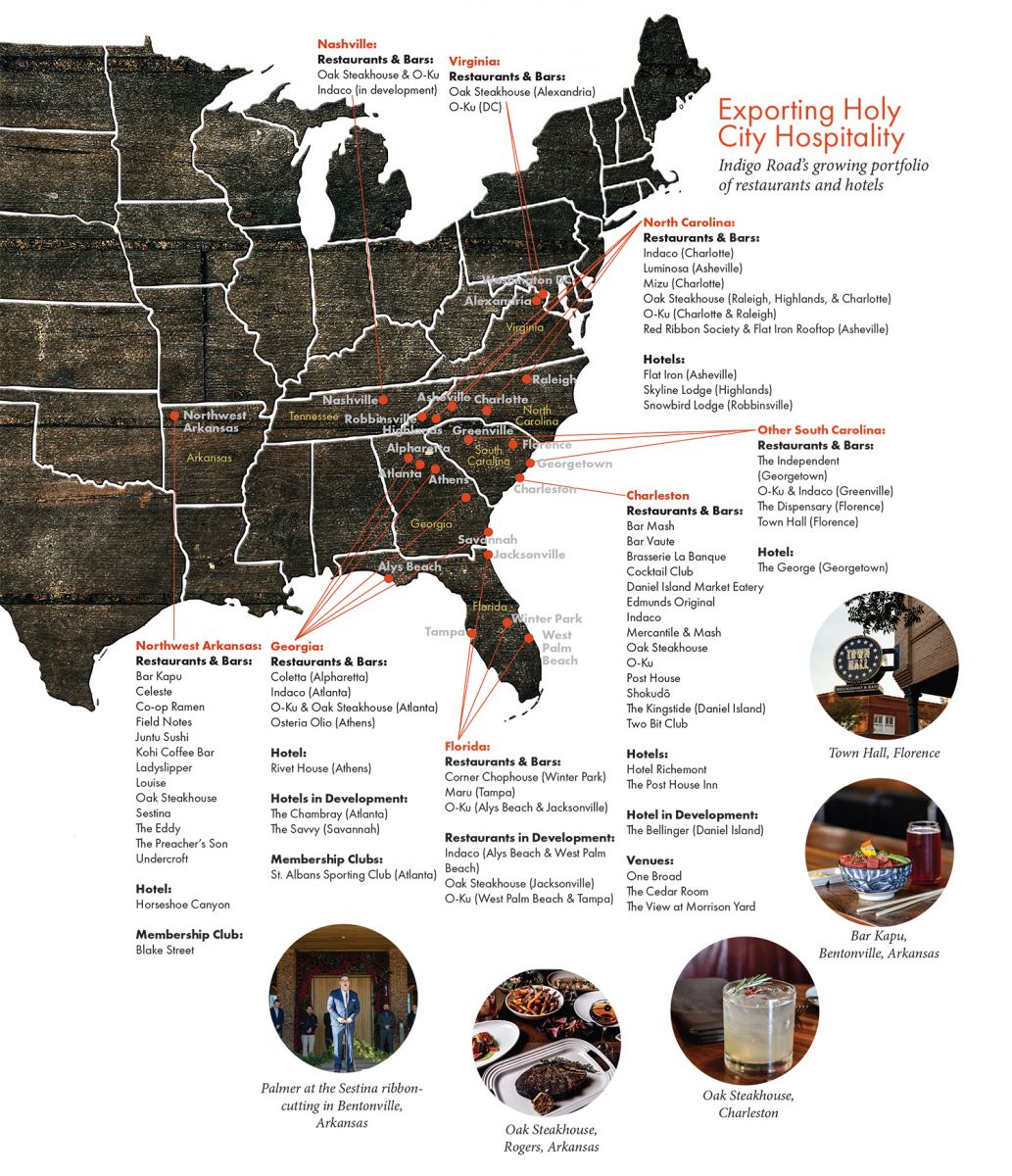
One meeting is how the founder of the Charleston-based Indigo Road Hospitality Group ended up operating 13 restaurants and bars in northwest Arkansas, 1,000 miles inland from the South Carolina coast. One day, Palmer recalls, two of the investors in Indigo Road’s Greenville restaurants called to ask, “‘Would you take a ride with us out to Bentonville?’ I said, ‘Sure.’”
That meeting led to Indigo Road’s opening Junto Sushi and Bar Kapu inside the Motto by Hilton Bentonville and an Oak Steakhouse in nearby Rogers. Then, he took another meeting, this time with Tom and Steuart Walton, grandsons of Sam Walton, founder of Walmart, which is headquartered in Bentonville. As the multinational company competes for talent these days against other giants like Amazon and Microsoft, “Bentonville’s got to be a great place to live,” Palmer says. “So, the Waltons built 600 miles of mountain bike trails that are maintained by the family. [Their aunt] Alice is building the Health Care Campus. They’re building a university to teach robotics and AI, and they’ve started a couple of restaurants.”
That’s what the meeting was about. “They had a restaurant group called ‘Ropeswing,’” Palmer says, and they told him, “We want to be in the real estate business and the vision business, but we don’t want to be in the operations business. And they’ve got a big vision for the area.” Palmer says Indigo Road is all in on Bentonville. “It reminds me of Charleston 15 years ago,” he says, “where everybody was just kind of buying into the city. Bentonville is in that phase where it just feels like everything is going right.”
A lot of things have been going right for Indigo Road, too. In 16 years, the group has grown from a single Charleston steak house to 40 restaurants in seven states. And with a dozen more in the works, Palmer and his team show no signs of slowing down.
In 2009, Palmer found himself unemployed. He had spent five years opening restaurants for Ginn Resorts in Florida before the financial crisis forced the company to make layoffs. The last place he intended to go was back to Charleston.
He had previously worked in the city’s restaurant industry from 1991 to 2004, culminating in a four-year stint as general manager at Peninsula Grill, during which he spiraled into alcohol and drug addiction. Palmer details that dark period in honest detail in his 2019 memoir Say Grace (Forbes Books), and he credits owner Hank Holliday and the late chef Bob Carter with saving his life by getting him into rehab. After two years of sobriety, he left the Holy City, thinking it was for good. “Charleston is a small town,” he writes in Say Grace, “and the restaurant industry is insular….people still thought of me as ‘the guy that has gone to rehab.’” He was interviewing for jobs across the country when investment banker Michael Meyer called.
Meyer and his business partner, Andy O’Keefe, were running Oak Steakhouse on Broad Street, and the restaurant was struggling. Palmer agreed to take on a short consulting gig to help turn things around. Within 30 days, he was asked to come on as managing partner, but Palmer was hesitant. He told Meyer and O’Keefe that, counterintuitively, they needed to open more restaurants if the steak house were to survive. “We were so slow,” he remembers. The geography of Charleston dining was shifting, moving up the peninsula away from East Bay and Broad streets. Besides, he adds, “I had bigger ambitions than running one restaurant. I took a 70 percent pay cut to come do this thing. I wanted to do more.”
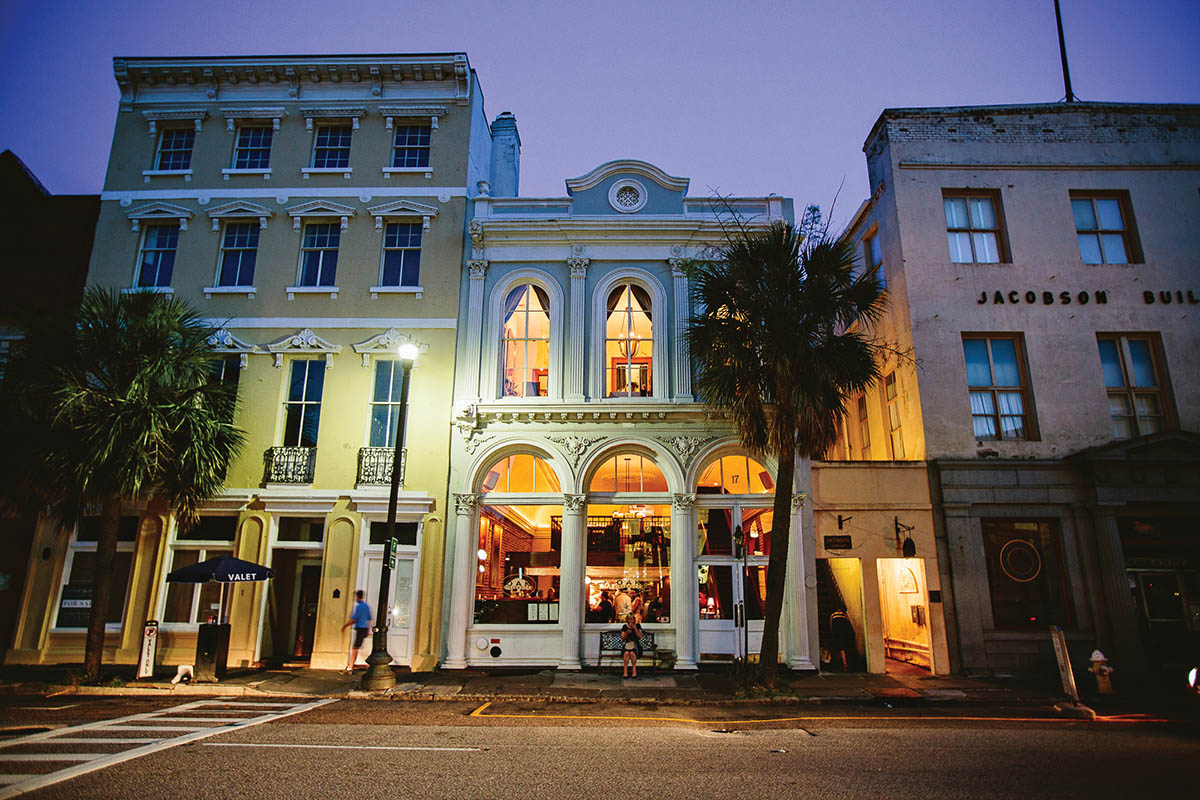
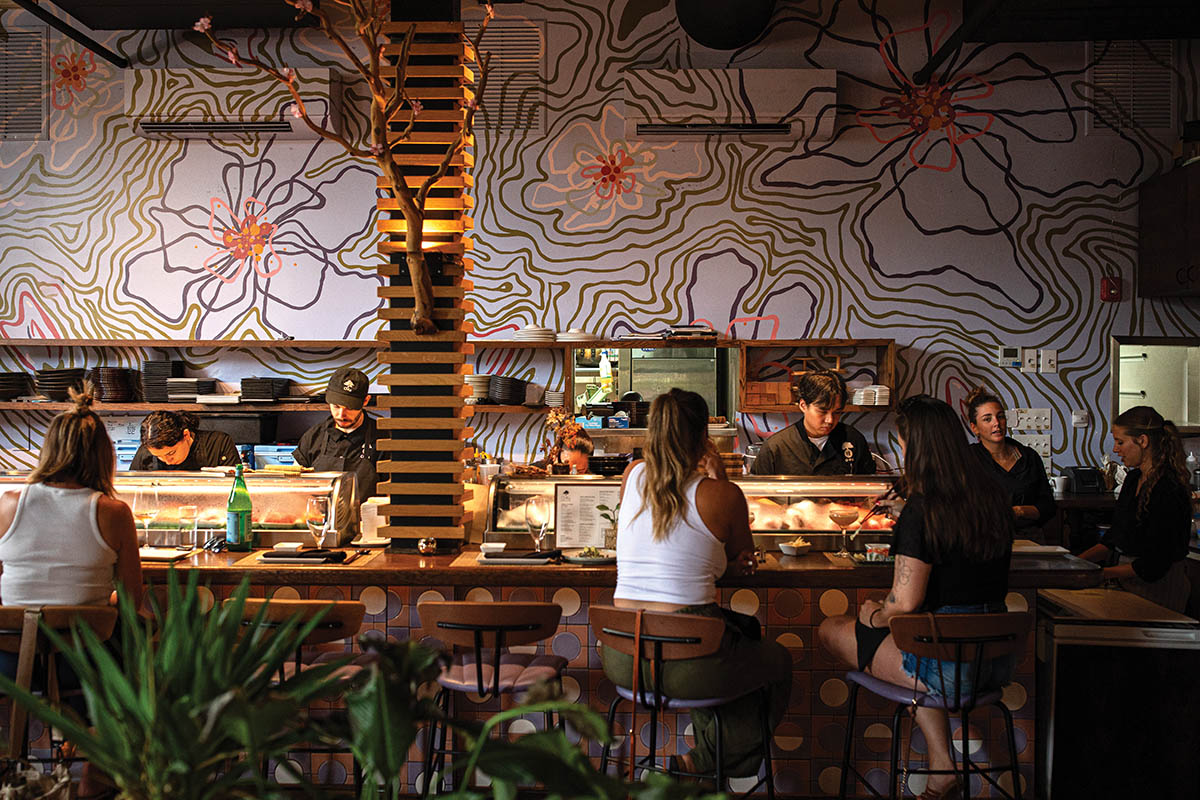
His partners agreed, and the Indigo Road Hospitality Group was born. They opened their next restaurant, O-Ku Sushi, on King Street in March 2010, and The Cocktail Club the following summer. That expansion helped Palmer recruit Jeremiah Bacon, then chef at Carolinas, to take over the kitchen at Oak with the promise of helping launch a fourth restaurant called The Macintosh.
“Ironically, I would tell you The Macintosh saved us,” Palmer says. By the time the farm-to-table restaurant opened in fall 2011, the Upper King neighborhood, once a largely abandoned retail corridor, had become Charleston’s hot new dining district. “People came [to The Macintosh],” Palmer says, “because it was the new thing, and a funny thing happened. Those folks started going, ‘Wow, this is delicious. This is the guy that’s now at Oak. Maybe I should give it a second try.’ It created enough of a buzz that we saw Oak sales start to climb. “If we hadn’t opened The Macintosh,” he says, “I don’t think Oak would have made it.”
In the space of three years, Indigo Road had gone from running one failing Charleston restaurant to running four successful ones, and the group was just getting started.
Indigo Road made its first move outside Charleston in 2012, when it opened Oak Table in downtown Columbia. Two years later, it pushed beyond South Carolina, opening a second Oak Steakhouse in Atlanta, the city where Palmer had gotten his first dish-washing job at the age of 13. When asked if expanding outside Charleston made him nervous, Palmer replies, “Oh, I was scared to death. The chef [in Atlanta] quit after three months. That first year, there was a lot of ‘What the hell have I done?’”
One thing they didn’t do was create carbon copies of the flagship Oak. “You could never recreate that building on Broad Street,” Palmer says. “If you tried, it would look like Disney World. When we open an Oak, we tell the team they have to use Certified Angus Beef because we believe it’s the best beef, but after that, we let the chef write the menu. There are [now] eight Oaks, but it’s eight different menus with eight different chefs’ interpretations.”
A large market like Atlanta was a logical place to have gone. The company’s next destination was less obvious: Florence, a city of 40,000 in the heart of South Carolina’s Pee Dee region. Palmer has a short explanation for the move: “My one meeting rule.” Two area businessmen, Ken Ard and Dale Barth, asked him to drive up to the former railroad hub at the intersection of interstates 20 and 95 to look at some abandoned downtown buildings they had acquired. “I asked, ‘Are you guys looking for money?’” he recalls. “They said, ‘Oh, no, we have the money. As part of this revitalization effort, we want to be able to say we got a Charleston restaurateur to come do a restaurant.” That sealed the deal. “You pretty much got me when you say, ‘We want to tell a story.’”
The result was Town Hall, and though it doesn’t do the volume of Palmer’s Charleston restaurants, it turned out to be a good move. In addition to anchoring the revitalization of Evans Street, Town Hall proved Indigo Road could export its style of restaurants to small cities as well as large ones.
Opening restaurants in smaller markets comes with its own challenges, like finding workers with fine-dining experience. “For a lot of these remote openings, we’re having to bring Charleston [staff] with us… and pay very expensive Airbnb bills. We are literally exporting Charleston,” Palmer says. “When we opened O-Ku Jacksonville,” he adds, “we didn’t have one local employee in the kitchen. You almost had to get open to show people we’re legitimate, and then their résumés would come.”
With the template in place, Indigo Road was ready for growth. It pushed into North Carolina in 2016 when it opened an O-Ku Sushi in Charlotte and into Tennessee in 2017 with an Oak Steakhouse in Nashville. At the onset of 2020, the company was operating 24 restaurants between Atlanta and northern Virginia.
Along the way, Palmer was earning the friendship and respect of some of America’s most acclaimed restaurateurs, like Danny Meyer of New York’s Union Square Hospitality Group. “We met for the first time when I was in Charleston for one of the Wine & Food festivals,” Meyer recalls. “He invited me to come speak to his team, and it was clear we were cut out of a similar cloth in terms of our perspectives on hospitality and putting our team members first in order to take even better care of our guests.”
Palmer, Meyer notes, is “an avid learner” who travels widely and visits many other restaurants for inspiration, including Meyer’s Gramercy Tavern and Union Square Café. “The guy you see in Charleston,” he says, “is the same guy you see when he comes to New York. It’s almost as if he’s taking care of my staff. He doesn’t dine in one of our restaurants without the staff members feeling like they’ve learned something from this guest.”
A decade into Indigo Road’s journey, Palmer was ready to take those lessons in hospitality into new markets. In January 2020, the company announced plans to open a boutique hotel. When asked why he decided to move into lodging, Palmer laughs. “Because I have a hole in my head,” he says.
It was actually prompted by the experience of running restaurants in other companies’ hotels. “They just weren’t that hospitable, to be honest,” Palmer says. “I knew we could do such a better job of welcoming people. If we’re doing the food and beverage, we might as well do the rooms. So, we started a lodging division, and then, COVID hit.”
Their first project was the Skyline Lodge near Highlands in the North Carolina mountains. “A student of Frank Lloyd Wright, Albert Kelsey started designing it in 1928. It was one of the first open courtyards in America,” Palmer explains. “We went up there in the middle of masks and lockdown and honestly stumbled upon it.”
A succession of owners over the years had added redwood interiors, stone fireplaces, and a restaurant, but by 2020, the aging structure had fallen into disrepair. “Like any historic renovation,” Palmer says, “we didn’t think we were going to have to go all the way back to the studs—and then we had to go all the way back to the studs.” As the renovations dragged on, the costs almost doubled, but Skyline Lodge opened in the summer of 2021. Indigo Road was officially in the hotel business, and seven more properties, including Hotel Richemont on Society Street, have followed.
Not all of Indigo Road’s ventures over the years proved successful. In 2018, the company sold Oak Table in Columbia to Charleston’s Hall Management Group, which converted it into a Hall’s Chophouse. The Granary, Indigo’s first venture into Mount Pleasant, shuttered after five years, and the Mexican-themed Maya, which replaced The Macintosh on King Street in 2021, lasted just three. The hit rate, though, has been high, and the flagship Oak Steakhouse on Broad Street celebrated its 20th anniversary last year. With such a track record, Palmer could have comfortably stayed within the Carolinas or just stuck to the restaurant game. Why go further into hotels—or cross the Mississippi?
“It’s not money,” Palmer says. “I think money is the by-product. I was 40 before I owned my first restaurant. What I heard in our industry was, people aren’t making enough money. There are no health benefits. The cultures are toxic.” Scale, he says, makes changing that possible. “I am able to say to a general manager who’s doing a great job at one restaurant, ‘Hey, would you like to oversee two, and I can give you a 30 percent raise?’”
More than 2,200 people now work for Indigo Road, and they need room to grow. “We have three or four dozen people making over six figures,” he says, “and that means something to me. We have 27 people on our senior team.”
Palmer points with pride at the company’s home loan program. “We give the employee a down payment, and they have three years to pay it back interest free. We’ve helped dozens of people buy homes.”
More than anything, Palmer says, he wants to give back to an industry that has given so much to him. “This is one of the rare industries,” he says, “where it doesn’t matter how you grew up, college education, color of your skin, anything. If you can come in, work hard, and be part of a team, there’s a place here.
“There was a place for me,” he continues. “I have an eighth-grade education. I got a GED and went to College of Charleston for one semester, then the drugs and alcohol....” As he puts it in Say Grace, the hospitality industry is one of “perplexing contradictions.” It enabled his addiction so readily, but it also led him to “wonderful, caring people who helped bring me back from the brink.”
Meyer sees Palmer himself as one of those wonderful, caring people. “Maybe because of what [Steve has] experienced in his own life,” Meyer says, “he understands the power of caring for other people. I think a lot of us in the restaurant business do for others what perhaps we had always wished others would do for us, and he seems to be on overdrive with that, as a boss, as a host, and as an industry leader.”
Palmer remains bullishly optimistic about the industry and about Charleston. In October, Indigo Road opened its newest local restaurant, Shokudô, in the space on Upper King that formerly held The Macintosh and Maya. It’s a modern Japanese tavern featuring kushiyaki skewers cooked on a robata grill, the brainchild of chef/partner Masa Hamaya, who formerly oversaw the O-Ku restaurants.
Once again, Palmer is putting his faith in his chefs. Is King Street the right place for such an offering? “I have absolutely no idea,” Palmer says, “but if it doesn’t work, it won’t be because of the quality. I trust [Hamaya] that much.”
“People will ask, “Well, what’s the strategy?’” Palmer adds. “I don’t have one. Somebody from Greenville’s going to call and ask me to fly to Bentonville. I have no strategy [except] to grow a good company where employees love coming to work, and we get to make great guest experiences.”
So far, that’s worked out pretty well.
Watch Palmer interview F&B industry titan Danny Meyer on his Say Grace podcast: